The Five-Star Safety Paradox: When Perfect Crash Test Scores Don't Protect Real Drivers
The Comfort of Stars and Numbers
Few automotive features provide more psychological comfort than a five-star safety rating. The National Highway Traffic Safety Administration's star system and the Insurance Institute for Highway Safety's awards create a seemingly objective hierarchy of protection. Shoppers routinely choose vehicles based on these ratings, confident they're making data-driven decisions about their family's safety.
 Photo: Insurance Institute for Highway Safety, via thumbs.dreamstime.com
 Photo: National Highway Traffic Safety Administration, via www.middleeasteye.net
But safety testing operates in a controlled universe that bears limited resemblance to the chaotic environment where real crashes happen.
The Laboratory vs. Reality Problem
Crash tests are marvels of scientific precision. Test vehicles hit barriers at exactly predetermined speeds and angles. Crash test dummies are positioned perfectly, wearing seatbelts correctly, with seats adjusted to standard specifications. The impacts occur under ideal conditions with no variables like weather, road surface, or driver behavior.
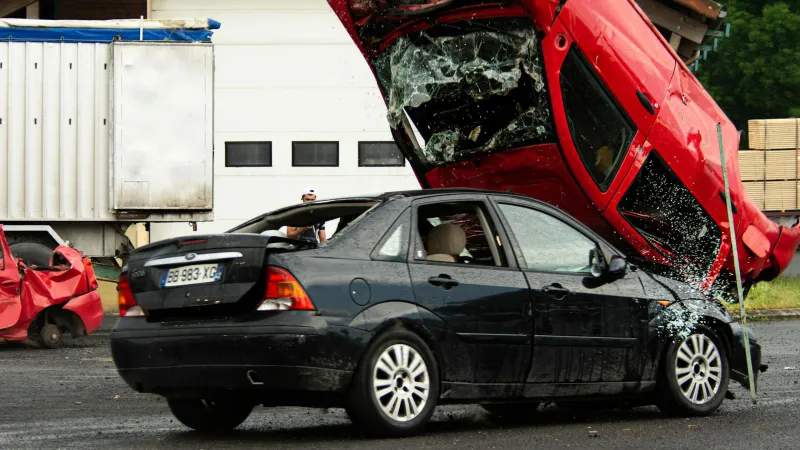
Real-world crashes are nothing like this. They happen on wet roads, at odd angles, with distracted drivers who may not be wearing seatbelts properly. Vehicles often hit objects other than flat barriers—trees, guardrails, other vehicles moving in different directions. The speed differentials, impact angles, and environmental factors create infinite variations that no test protocol can capture.
This isn't a flaw in the testing system—it's an inherent limitation. Tests need standardization to be meaningful, but standardization inevitably creates gaps between laboratory conditions and real-world chaos.
The Specific Blind Spots
Certain types of crashes that are common on American roads receive limited attention in standard safety testing. Rollover scenarios, while tested, don't capture the complex dynamics of how SUVs and trucks actually flip in real situations. Side-impact tests use specific impact points that may not align with how vehicles actually collide at intersections.
Pedestrian and cyclist safety has only recently become part of testing protocols, despite these accidents representing a significant portion of serious injuries and fatalities. Many vehicles with top safety ratings for occupants perform poorly in pedestrian impact scenarios.
The testing also assumes proper use of safety systems. A vehicle might earn top marks for its automatic emergency braking, but real-world effectiveness depends on drivers understanding the system's limitations and maintaining it properly. Many owners never read their manual and don't realize their "safety" features only work under specific conditions.
The Size and Weight Factor
Crash tests typically compare vehicles within similar size categories, but real roads mix vehicles of dramatically different weights and sizes. A compact car might earn five stars in its class while being fundamentally less protective than a larger vehicle with lower ratings. The physics of crash energy absorption favor larger, heavier vehicles in ways that star ratings don't always capture.
This creates a safety arms race where individual protection comes at the expense of overall road safety. When everyone drives larger vehicles for safety, the increased mass and height differences actually make crashes more severe for everyone.
What the Insurance Data Shows
Insurance companies track real-world crash outcomes, and their data sometimes contradicts laboratory test results. Vehicles with identical safety ratings can have vastly different injury rates and repair costs. Some cars that excel in crash tests perform poorly in real-world scenarios due to factors like visibility, driver behavior patterns, or how the vehicle encourages risk-taking.
The Highway Loss Data Institute publishes studies showing how vehicles actually perform in insurance claims, providing a reality check on laboratory test results. These studies often reveal that safety features tested in isolation don't always work as expected when combined with real driving conditions.
 Photo: Highway Loss Data Institute, via www.hdwallpapers.in
The Human Element
Crash tests assume rational, prepared occupants, but real crashes involve surprised, possibly impaired, or distracted humans. A vehicle's safety systems might work perfectly in testing but fail to account for how people actually behave in emergency situations.
Driver assistance technologies can create their own safety paradoxes. Features designed to prevent crashes sometimes encourage complacency or risky behavior. Drivers may rely too heavily on automatic systems or become less attentive because they believe the car will save them.
Beyond the Stars: A More Complete Picture
Smart safety-conscious buyers look beyond crash test ratings to real-world performance data. Insurance loss records, highway fatality statistics by vehicle model, and long-term reliability of safety systems provide crucial context that star ratings miss.
Visibility characteristics matter enormously for crash avoidance but receive minimal attention in standard ratings. A vehicle's blind spots, sight lines, and how its design affects driver awareness often matter more than its crash test performance.
Maintenance requirements for safety systems also deserve consideration. Some vehicles require frequent calibration of their safety technologies, and the cost and complexity of keeping these systems functioning properly affects their real-world effectiveness.
The Bigger Safety Picture
The most effective automotive safety improvements often happen outside the testing protocols that generate star ratings. Road design, traffic enforcement, driver education, and vehicle maintenance have historically prevented more crashes than any individual vehicle safety feature.
Understanding crash test limitations doesn't mean ignoring safety ratings—it means using them as one data point among many. The safest approach combines good test scores with real-world performance data, appropriate vehicle choice for your specific driving patterns, and recognition that the most important safety feature is still the driver.
Five-star ratings provide valuable information, but they're not a guarantee of real-world protection. The gap between laboratory perfection and road reality means that truly safety-conscious buyers need to look beyond the stars to understand what will actually keep them safe.